Blog

Marketing Executives' Focus on Social Media ROI Should Lift The Role Of Analytics

  • March 3, 2010
  • By Pat in: , ,
  • Read Comments (2)

There’s a lot of promise in research released yesterday by the Marketing Executives Networking Group (MENG) and Anderson Analytics. MENG is a national group representing senior marketing executives from across industries. Until the revolution when digital marketers claim their rightful place as eCMOs or some such, these are the people who green-light online plans. (At this point, I should say that I’m a MENG member, agitMENGMarketingExecutivesNetworkingGroupImageating on your behalf from the inside.)

It’s good news that two-thirds of respondents to the Third Annual Marketing Trends Study have a more optimistic business outlook for 2010. Marketing budgets are being increased (by 24% of respondents), innovation and research and development (R&D) is being funded (36%) and about 30% of executives say they’re hiring.

You can find a complete copy of survey results at www.mengonline.com/visitors/newsroom. We went straight to the Online Marketing & Social Media Strategy part of the report and there it was. Overall, marketers intend to spend 45% of their budgets online this year, 55% offline. Nice, very nice.

Company size factors into the spending. Large companies (defined as having 2,000 or more employees) will spend just 30% of their budgets online versus 48% spent by small companies. That’s OK, large companies have bigger budgets. The dollars will be there.

Research is conducted to answer questions, but one looming question emerged out of this research: Will the results of heightening spending be there?

The MENG/Anderson survey is comprehensive and covers a range of topics from executives’ assessment of growth in geographic markets to their own job satisfaction. We were interested in the list of marketing concepts that respondents consider “the most important to pay attention to.”MENGMembersTopMarketingConcepts2010

Marketing executives’ top marketing concept for 2010? Marketing ROI. And, Social Media ROI ranked as #15.

Return on investment, that again. The ROI mandate is inescapable this year (see our post on asset managers' special challenge in demonstrating social media ROI).

But take a look at the marketers’ list of top 15 marketing concepts. Where’s Web analytics? How can anything online be evaluated without a focus, at the top of a marketing organization, on analytics?

Digital marketers, this is your call to arms. Web analytics—and we’d broaden the term to make sure it encompassed analytics of off-site strategies, too—ranks #19 on the MENG/Anderson list of marketing concepts that executives are focusing on. That’s too low for what needs to be demonstrated and understood in 2010.

This data, which may or may not reflect responses from asset management marketing executives, confirms what asset managers’ Web analysts already know. At too many organizations, analytics is a siloed capability, typically too low in a marketing structure and almost always focused on reporting as opposed to taking part in planning, anticipating, learning, testing and sharing.

In this year of “Where’s the ROI?” digital marketers need to seize the moment to communicate the value and limitations of analytics. Don’t fault the marketing leaders for analytics not being top of mind. It’s your job to command their attention. Find a way to present insights (not auto-generated reports) that widen executives’ eyes as opposed to glaze them over.

Your work, your organization’s online presence and its future effectiveness depends on your speaking up this year. Take another look at that list—how hard could it be, really, for Web analytics to unseat Blogging as a top marketing concept? Go.

What’s Good On This Site? Popular Content Lists Create A Community Feel

  • March 1, 2010
  • By Pat in: ,
  • Read Comments (2)

Participation, engagement, community—asset manager Web sites have a long way to go to foster these. Ultimately, in all likelihood, most companies will cede community-hosting to Facebook or other social networking sites.

But don’t be too quick to assume that you can’t deliver community-like value for your Web site visitors. Two unconnected news items took place last week that might trigger some ideas.

iTunesSells10BillionSongsImage
Example 1: It was an impressive accomplishment Thursday when the 10 billionth song was sold in the iTunes store, but it was a long time coming. And ultimately that story was about Apple’s innovation.

Concurrently, Apple released a list of the top 25 most-downloaded songs. To us, this was the more interesting announcement. Each of us knows what we bought from iTunes, but Apple aggregated all of those 99-cent (mostly) purchases and told us the rank order of what we all bought.

Example 2: Earlier in the week we were intrigued by the basis of an InvestmentNews.com article. “The ETFs financial advisers can't get enough of” wasn’t based on sales, performance or even survey data.

Rather, it was a list of the top 10 ETFs advisors researched most in 2009 using the Morningstar Advisor Workstation (and provided by Morningstar). Morningstar, Investment News and ETFTrends.com (which provided an expanded analysis of each ETF on its site) all saw the information value in advisor searches. (Are the searches predictive? We wished one of the media sites compared the top-searched to top-selling.)

Here again, users of the Advisor Workstation knew what they were looking for last year. But Morningstar was in a unique position to rank and share what all financial advisors were looking for.

By now you’re getting the idea, right? What insights could you share, externally and internally, about your customers’ use of your Web site and other digital products? Most viewed, most downloaded, most emailed, most ordered, most searched content all are possibilities for you to consider publishing.

VanguardMostViewedImageCommon on many sites today, most popular or trending lists are few and far between on asset manager sites. We’ve seen them on Vanguard’s site (list shown at left) and behind the password on BlackRock’s financial professionals site. If you’re aware of others, please fill us in by commenting below.

Adding such lists to your site will provide a few benefits. You’ll see that many users use them as navigation, more so than your “What’s New” listings.

By definition, “What’s New” is driven by your firm’s timetable. With their views, your users are pointing to valuable content for others who follow them (and if you haven't been paying attention to your Web analytics, there may be some surprises for you). Publishing a list of “Most Popular” content is as close as your FINRA-regulated site may get to users’ endorsements.

But don’t stop at just publishing the lists online. You can create content based on your users’ content consumption trends and preferences, the more segmented the more valuable.

As unformed as it may be, there is a community of users on your site daily. What would it take for you to begin representing their collective interests to one another and to your firm?

USAA App, Mint.com Cross-Selling, TradeKing Rate As Forrester Best Practices

  • February 23, 2010
  • By Pat in: , ,
  • Add Comment

We sat in on a Forrester Research Top 10 Financial Services Web Site Best Practices of 2009 Webinar this afternoon and thought we’d pass on a few highlights.

App Turns Phone Into An ATM

USAA’s mobile phone app (released first for the iPhone and in January for the Droid) enables registered accountholders to deposit checks simply by photographing the check and submitting the image via the phone.

USAADepositMobileImage

We covered remote deposit capture (RDC) seven years ago when the payments industry introduced it as a solution for commercial customers that met volume requirements. It's exciting to see the capability downstreamed to consumers for one-off use.

Brad Strothkamp, Forrester principal analyst, singled the app out for two reasons.

First, it’s a best practice of offering content differentiated from what Internet banking applications offer. If you're working on a mobile strategy for an asset management company, be sure to consider the medum—offering just a miniature version of your mutual fund or ETF site won't cut it.

But more important, this app is an innovation that makes doing business with USAA easier.

According to USAA's January press release announcing the Droid app, in the five months since Deposit@Mobile was introduced in August 2009, customers deposited more than $300 million using their iPhones.

USAA provides financial services (including mutual funds) to military members and their family—a very mobile group. More than 1.2 million members use USAA's mobile platforms to manage daily transactions.

Mint.com Bases Cross-Selling On Potential Savings

Mint.com, the online personal finance site we've been encouraging you to keep an eye on for the audience it's building and the tools it's delivering, is now doing “smart” cross-selling based on transactional information. According to its site today, more than 1 million people have uploaded their checking, savings and investment account information to Mint and 3,000 are signing on each day. Mint is tracking $175 billion in transactions, $47 billion in assets and has identified more than $300 million in potential savings for its users.

In the cross-selling example that Strothkamp cites, when Mint "sees" discount brokerage commissions, it can cross-sell a lower-cost provider. Let’s set aside the other discussion we could have—i.e., How long until Mint begins to cross-sell based on mutual fund expense ratios?—this is smart Web site functionality.

Social Media Stimulates Trading

The TradeKing community is a Forrester favorite and you can read more about it on the Groundswell page. The community allows for traders to share trade and balance information at the aggregated level. Most intriguing in Strothkamp’s comments was that TradeKing finds the more active a trader is in the social community, the more they trade—four times more!

Across financial services businesses, “there’s a lot of interest in figuring out social tools,” Strothkamp said.

How Much Traffic Is Facebook Driving To Your Site?

“That wouldn’t apply to us because… [wait for it] we’re in a regulated industry.”

There’s an underlying current in asset management marketing that trends that affect other industries don’t apply here. It’s an illusion that is almost never true online—what’s affecting other Web sites is probably affecting your mutual fund or exchange-traded fund (ETF) site, too.

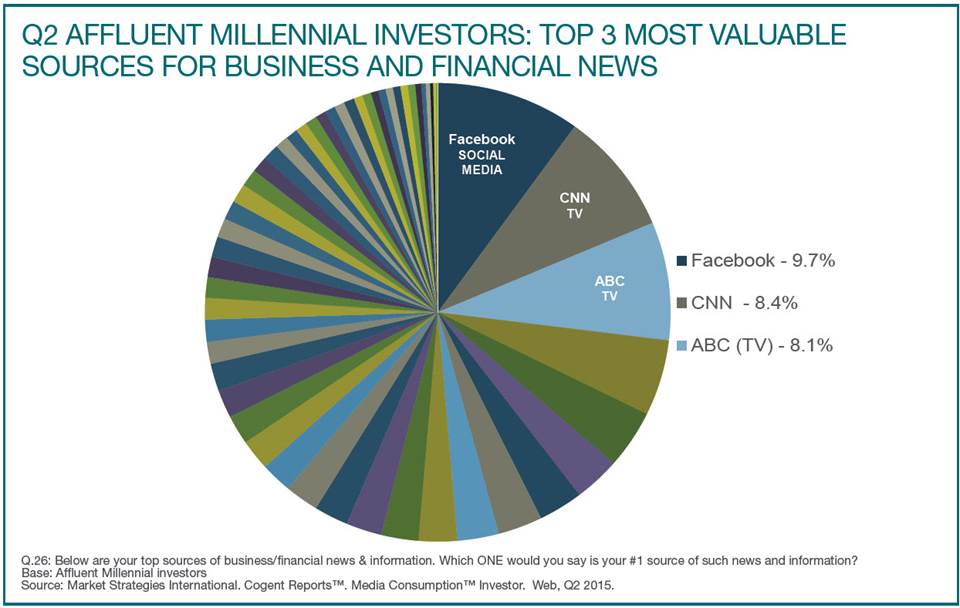
We’ve written about how Facebook and other social networking sites are gaining at the expense of asset manager and other destination Web sites.

But there was a report this week about Facebook’s influence in driving Web site traffic that merits attention. Compete.com data cited by the San Francisco Chronicle on Monday suggests that Facebook is now a more important traffic driver than Google.

“Facebook has passed search-engine giant Google to become the top source for traffic to major portals like Yahoo and MSN, and is among the leaders for other types of sites,” the Chronicle reported.

Other types of sites even including investment manager sites? Yes, according to Compete.

Here’s what we found when we took a look at the Compete referrer data for the top 30 (based on assets under management) mutual fund and ETF sites for January 2010. Facebook.com appears on Compete’s lists of the top five traffic referrers to five investment company sites: AmericanFunds.com, DavisFunds.com, Dimensional Fund Advisors (Dfaus.com), Fidelity.com and GMO.com.

 Facebook Ranks Among Top Referrers to 5 Investment Company Sites (January 2010)

Investment
company
site
(Links go to Compete referrer page)


Facebook’s rank as a top 5 source of site traffic


Referrer share
(The monthly share of referral traffic generated by the site compared to all of its referral traffic)
The change in Facebook’s share from December 2009 The change in Google’s share from December 2009
AmericanFunds.com  #4   3.5%  +44.6%  + 8.2%
DavisFunds.com  #2  18.2%  New  -93.6%
Dfaus.com  #5  Low data  No data  -55.0%
Fidelity.com  #5   2.45%  -12.17%  -  7.2%
GMO.com  #4  10.2%  +92.2%  -17.5%

Source: Compete.com

The sites experience very different total traffic levels. Given the Davis Funds' site relatively low traffic and few (24) sites referring traffic to it, Facebook's appearance as a top referrer in a given month might be easy to understand.

But Fidelity and American Funds are industry behemoths and, try as we might to produce alternative explanations, there’s no denying Facebook’s breakthrough as a top referrer. Fidelity.com is the 157th largest site, according to Compete. More than 12,000 sites refer traffic to it and yet Facebook catapulted over those to rank as the fifth top referrer in January? Fidelity's self-directed investors could help explain the popularity and influence of Facebook. But a heavy retail bias doesn't help explain Facebook traffic to American Funds, sold exclusively through financial advisors.

The implications of Facebook supplanting Google as a top traffic driver is being contemplated across all industries this week. We invite you to provide your own interpretation and comments below. Here are a few of our thoughts:

Your Referrer Data

The San Francisco Chronicle report was based on a single month's data (December 2009), and this post is based on one month, as well. One month is what Compete makes available at no charge. In fact, if you follow the links included in the table above to the Compete profiles after the January 2010 data rolls off, you may see a different result.

It's possible that other fund companies are getting more Facebook traffic in absolute numbers but, because their other referrers are more dominant, Facebook is lower on their list of referrers.

Site traffic is reported using multiple measurement methods. Compete reports clickstream data based on a 2 million-member panel of U.S. Internet users. It’s common for Compete, comScore and Experian Hitwise and Quantcast data to be at odds.

Bottomline: The availability of the Compete data makes this comparative analysis possible. If you’re responsible for digital strategy at your firm, you need to dig into your own Web analytics to better understand where your Facebook traffic is coming from, where it’s going and its quality.

Facebook Links To Investment Sites

Of the five firms, Fidelity has a Facebook page with little more than 1,000 fans, and American Funds has a page for members of its Web group only. We couldn’t determine whether advertising links from Facebook count as referred traffic by Compete. Even if it is, our guess is that only Fidelity would be a likely aggressive Facebook advertiser of these five.

In the absence of robust Facebook pages or ads, that must mean that the Facebook traffic is coming from links posted in the Notes areas. Amazing, almost incredible. Congratulations to these companies for producing content that others think enough to link to. To get a sense of it, do a dfaus site:facebook.com search on Google and see the links from Facebook pages of advisory firms. Institutional firms that have thought that social media is just for retail investors might want to think again.

Forget Search To Focus on Facebook Optimization?

Some have interpreted the ascent of Facebook as a traffic driver, often accompanied by a decline in Google-referred traffic, to mean that people are no longer searching and increasingly prefer to discover content socially. Such a shift in Web user behavior would have significant implications for search engine optimization (SEO) and search marketing. That’s true in particular for digital strategy planning in this business, where much SEO remains to be done.

We agree with this post on Search Engine Land that aims to put the Facebook findings in context. The work involved in thinking about how searchers frame their information requests and the measurement and analysis of the effectiveness of various keyword phrases can result in deeper customer and prospect understanding. Please don’t think that you can skip the work now that Facebook users are recommending investment site content—especially if these recommendations are not as a result of a deliberate strategy of yours.

Facebook—and its 400 million users—is awesome. But maintaining a Facebook presence requires a well-considered strategy and ongoing resources. In an October 2009 post, Facebook: Don’t Expect A Lot of Warm And Fuzzy, we noted a certain crankiness toward investment companies by Facebook commenters. (We saw the same early this month in the early reactions to Fidelity’s Be The Green Line YouTube contest.)

But while your Facebook page may be on a backburner pending strategy, policy and resources, we suggest you take this January 2010 referrer data as inspiration to learn more about Facebook. Your firm doesn’t need a fan page in order for you to explore more about how investors are interacting with your content and how they may want to interact with you. 

Mobile Next Year May Be One Year Too Late

  • February 10, 2010
  • By Pat in: ,
  • Add Comment

I like to experiment with Google AdWords, and today I received a report on the performance of an AdvisorTweets.com campaign that’s been running for a few weeks. I was shocked: Out of the 237 clicks on my ads, 188 were on mobile devices with full browsers. Almost 80% of those searching for “RIAs and twitter” (my Google AdWords keywords) were using phones?

This report is just another tiny piece to throw onto the pile of data about mounting mobile phone usage. Also in the Inbox today was an email about ComScore’s "The 2009 U.S. Digital Year in Review" including an analysis of the drivers that accelerate mobile phone use. Note that 3G phone ownership is now at 43%, according to ComScore.

ComscoreGrowthofMobileMarketEnablers2009

Oh and in its latest research, kasina reported that four out of five advisors use some type of mobile device and that the phone is how many access the Web.

Out of curiosity, I wandered over to the iTunes App Store to search for “investing” apps and then “mutual funds” and “ETFs.” In an industry with almost 8,000 mutual funds and 800 exchange-traded funds, guess how many investment companies have iPhone applications? Exactly two: Vanguard and TIAA-CREF.

Maybe you're working on your mobile strategy right now. If so, we'll keep this short so you can get back to it. But if your firm thought you had at least a year to think through your brand experience on a phone, you might want to reconsider your timing. 

Can you afford not to provide a mobile Web site, at the least, this year?

Is Social Media "Worth It" For Asset Managers?

  • February 3, 2010
  • By Pat in: ,
  • Read Comments (3)

FINRA held its long-anticipated Webinar on social media guidance today. (A replay will be available in a few weeks, social media vendor Socialware has posted a summary and we wrote a brief AdvisorTweets blog post.)

When we commented on the release of the guidance last week, we characterized it as FINRA kicking the ball into Compliance’s court. Well…not so fast—there’s somewhere else the ball has to go first and that’s to management. Management needs to be on board that “social media” is an appropriate use of what will be significant resources. (Read the Socialware document for a sobering look at what compliance with FINRA’s recordkeeping and supervision requirements entails.)

What is the Return on Investment (ROI) of social media? It’s a question being asked across all industries, but it’s especially germane to the highly regulated investment industry. At companies in other industries, maybe, a skunk works can be formed for experimenting on the cheap. Or the work might be outsourced at first. But that wouldn't work in this industry. Before the first tweet can take flight, expensive resources have to be consumed, ideally developing strategy and certainly focusing on risk mitigation.

And, for what? What are the stated expectations of social media? Or are managements being asked to take a flier? (Good luck with that.)

I had just completed presenting a Social Media Overview Webinar Tuesday afternoon when a question came in from one of the participants: “I hate to be a Debbie Downer, but how does it make me more money?”

When that’s the question that’s being asked, it demonstrates that we haven’t been broad enough in our discussion. That we haven’t focused on the transformation that’s going on in communications, with many of the trends leading away from what asset management companies rely on today. Interruption advertising, vanity collateral and product-based email blasts are fast becoming passé.

We haven’t been sufficiently disciplined in measuring what we do to understand that the effectiveness of our traditional communications is declining.

Can you think of a time when more people were talking about investing and the markets? It's not that investment managers’ products, services and personnel aren't relevant—it's the communications that are static and stale.

The idea that “markets are conversations” was a thought first articulated more than 10 years ago in the Cluetrain Manifesto. Web site users began talking to one another years ago on message boards. The online sharing of words and pictures and videos started in the last millennium, too, and today social bookmarking buttons and RSS feeds are ubiquitous on most Web sites.

Investment companies’ digital communications (and maybe the systems underlying them?) have trailed behind. FINRA's social media guidance cited Pew Internet and American Life Project research that 46 percent of American adults who use the Internet logged onto a social networking site in 2009. And yet, investment management communications rarely figure into online conversations. Out of sight, out of mind.

Online, where marketers compete with content, the rich, well-substantiated (thank you, Compliance) commentaries, whitepapers and other research you and your colleagues produce are overlooked by search engines. Web searchers looking for the very information your company offers end up reading inferior, shallow content on SEO-optimized article submission sites.

Social media represents a full-on assault on the way communications are planned, processed, published and evaluated within many investment management companies today. Even setting aside the compliance parameters, there is a lot of work to do to figure out how asset managers can meaningfully interact online.

What's the ROI of social media? That's the right question for management to ask. But if you're asking for a social media budget, we encourage you to recast your question. You don't need funds to develop a Facebook application or invest in an archiving solution. You need support to disrupt current communications practices and seize cross-functional time and attention to focus on a more contemporary, more effective, better measured approach to communicating and marketing.

Does your company want to grow? Do you need to raise awareness of what you do and how you do it? Would you like to know your clients better and respond to them more quickly and more relevantly? How close are you to the market? How fresh is your product development? Could your organization stand to be more competitively alert?

Companies that are active on the social Web point to these as benefits, and that's where we'd start the conversation about the payback of a comprehensive social media strategy.

Slow Site? Optimize—Or Forfeit Search Traffic

Have your repeated requests to speed up your Web site been falling on deaf ears? There’s a change in the works that might give you the argument you need for IT to move site optimization up to the top of the priority list.

Watch this video from Google on the global benefits of a faster Web and then let’s consider how their advocacy on this could affect the success of your firm’s digital marketing strategy.


You’ve figured it out already, right? Of course, if Google wants the Web to be faster, the search engine is going to reward fast sites and slow sites can expect to sink in search engine rankings.

This isn't an arbitrary position on Google's part. Faster sites drive visitor satisfaction and conversions—they’re a win-win for site provider and user.

To get a rough idea of how your site will fare as search engine attention is directed to site speed, go to WebPageTest.org and run a test.

Below is a video of the test we ran. But first here’s some background. In a blog post a little more than a year ago, we used Google Trends to note slowly building interest in the search term "IRAs" toward the end of each year. But search interest was off toward the end of 2008, prompting us to suggest a compressed opportunity in the first four months of 2009 leading up to April 15.

That turned out to be true, as you can see in the graph below.

IRASearchTermGoogleTrendsImage

It’s essential to be discoverable by searchers when they’re looking, especially when the search term is important to your business. To illustrate the importance of winning speed races on key search terms, we're using an updated search term ("rollover IRA") and comparing the site speed results of three pages that currently rank on Page 1 of Google’s results.

They are pages on rollover IRAs from WellsFargo.com, Schwab.com and SmartMoney.com. To round out the quartet, we added a landing page from T. Rowe Price.com, a pay-per-click advertiser on the term.

We'll tell you what you're about to see and then watch for it in the video.

The results:

  1. Wells Fargo (bottom right quadrant in the video) was on top of our Search results and fastest to load at 4.5 seconds.
  2. T. Rowe Price (upper left), the pay-per-click advertiser, comes in second. Page speed is already a factor in Google AdWords quality score. We expected T. Rowe to do well and, in fact, it loads in 6.5 seconds.
  3. Loading at a slow 9.5 seconds is Schwab (bottom left).
  4. SmartMoney, which we included because publishers’ content-rich sites are among your toughest search competition, takes 14.5 seconds to fully load.


Is your site as fast as it needs to be to win rankings on Google? Our recommendation: Get with your IT partners and make sure they're aware of what's happening. (Maybe do a few competitor comparisons of your own.) To quickly bring them up to speed, refer them to WebPageTest.org. Also, Google maintains an excellent site on Web performance resources. Oh and better hurry!

Compliance: FINRA Bounces Social Media Ball To Your Court

  • January 25, 2010
  • By Pat in: ,
  • Read Comments (1)

The following was also posted at our AdvisorTweets.com/blog.

At about mid-day today, FINRA released its 10-page Guidance on Blogs and Social Networking Web Sites. (A tip of the hat to @BillWinterberg who was first among our tweeps to spot the regulatory notice.)

Others might disagree or read something in between the lines, but to us the guidance seems reasonable. Of course, FINRA will insist on record-keeping and supervision. And specific investment product recommendations are obviously trouble--in fact, FINRA says a prohibition would be a best practice unless the content posted was previously approved by a registered principal.

But we think that the door to the marketing potential of Twitter, LinkedIn and Facebook for financial advisors and firms swings open with FINRA's distinction between "static content" requiring the prior approval of a registered principal and "non-static content," which does not require prior approval.

FINRA acknowledges that Twitter and Facebook provide for non-static, real-time communications, such as interactive posts. "The portion of a social networking site that provides for these interactive communications constitutes an interactive electronic forum, and firms are not required to have a registered principal approve these communications prior to use," FINRA says.

This could have been the deal-breaker. What FINRA describes as static content on social networking sites--profile, background or wall information--must be approved by a registered principal prior to posting. It's more work for a Compliance review group but it's manageable. If, on the other hand, all tweets by everybody needed to be approved prior to posting, social networking would be dead on arrival for FINRA-regulated entities in the investment industry.

Please read FINRA's press release and the regulatory notice for all of the details.

There will be much more to come on this, including at the February 3 FINRA Webinar. (FINRA announced its rescheduling from March 17 via email this afternoon.)

From our perspective, the topic of social media participation today moved from "FINRA won't let us" to "How long will it take for Compliance to prepare our policies and procedures?"

This announcement is great timing for tomorrow's Investment News Webinar on Advisors and LinkedIn. See you there?

And, of course, we're interested in what you think of the FINRA guidance--as always, we welcome your comments below.